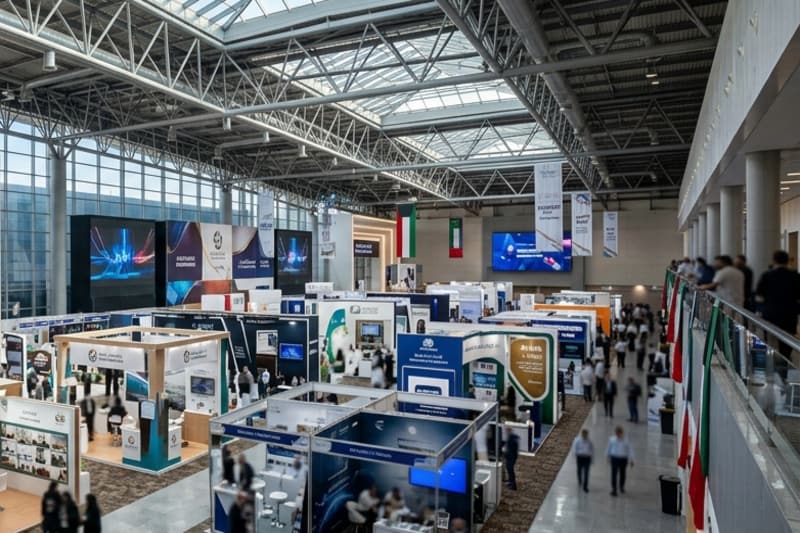
Exhibition and event work runs on fixed dates that don't move — a booth either opens on time or it doesn't open at all. That makes planning discipline even more important than in a standard fit-out project, where a delay usually just pushes back an opening date rather than missing an event entirely.
Planning Your Exhibition Booth Timeline
Work backward from the event date: booth design and approval, fabrication, and on-site build & setup each need their own buffer, especially for venues with strict move-in and move-out windows. Leaving booth planning until a few weeks before the event is the single most common cause of rushed, generic-looking stands.
Custom-Built vs. Modular Booths
Custom-built booths give full control over shape, branding and visitor flow, and tend to make the strongest impression at larger trade shows. Modular systems trade some of that flexibility for faster turnaround and easier reuse across multiple events — a reasonable choice for brands exhibiting frequently on a tighter budget. Booth consultancy at the brief stage helps decide which approach actually fits the event and budget, rather than defaulting to custom for every show.
Reception & Service Counters for Events
Reception counters and service counters built for an exhibition often have a second life afterward — in an office lobby, a retail unit, or a future event — when they're designed with that reuse in mind from the start. Worth discussing at the design stage if durability and repurposing matter to your budget.
Graphics, Branding & Corporate Giveaways
Booth graphics and branding should be designed alongside the structure, not applied to it afterward — panel sizing, lighting placement and graphic layout all interact. Concept design and CAD work for booths follows the same process as the rest of our 2D & 3D design services, so branding is planned into the structure rather than added last.
Roadshows & Multi-Venue Activations
Roadshow builds need to be designed for repeated assembly and transport, which changes the construction approach compared with a single fixed installation — materials, joinery and packing all need to survive multiple setups. Event management support, from delivery to on-site setup, keeps a multi-stop activation running without the brand team having to manage logistics directly.